
Knee osteoarthritis
Ongoing knee pain from arthritis that has not improved with conservative care. See our Advanced Knee Pain Center.
If pills, injections or physical therapy haven't helped, our vascular specialists can evaluate whether a minimally invasive, image-guided procedure may be right for you. Se habla español.
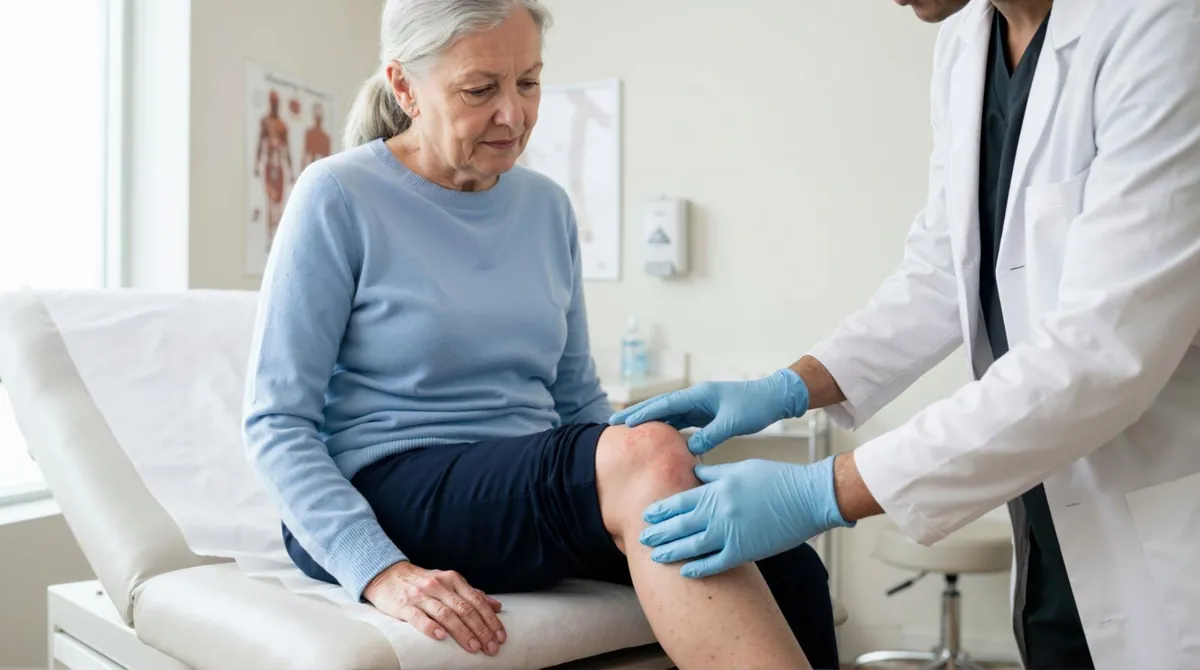
Advanced Joint Pain & Vascular Center, a division of Heart Vascular & Leg Center, offers consultations and follow-up visits for persistent joint and tendon pain in the knee, hip, shoulder, hand and heel. We also see patients for circulation, vein and wound concerns.
Your first visit is a screening to understand your pain and talk through your options, from conservative care to image-guided procedures such as genicular artery embolization (GAE). You do not need to know the name of a procedure to begin. Tell us what pain is keeping you from doing, and we will help you understand the next step.

Each center focuses on one part of the body, with the same team, location and approach.
Genicular artery embolization (GAE) is a minimally invasive, image-guided option for selected people with knee osteoarthritis pain. A screening visit helps decide whether it fits your diagnosis and goals.
Visit the center →For selected people with arthritis-related hip pain, our team evaluates whether transcatheter arterial microembolization (TAME) may be an option alongside conservative care.
Visit the center →For frozen shoulder, rotator cuff tendon problems and shoulder arthritis that haven't improved with therapy or injections, our team evaluates whether TAME may be an option.
Visit the center →For hand, thumb and wrist arthritis pain that hasn't responded to splints, therapy or medicine, our team evaluates whether TAME may be an option.
Visit the center →Persistent plantar fasciitis and ankle arthritis pain may be worth a closer look. Ask about our evaluation for plantar fascia embolization (PFE), an emerging option for selected patients.
Visit the center →Tennis elbow and other long-lasting tendon pain usually improve with standard care. For pain that won't improve, our team can talk through your options, including emerging ones.
Visit the center →Back problems can cause pain in the hip, leg or knee. Our team evaluates long-lasting lower back pain and sciatica and talks through options that fit you.
Visit the center →Leg pain when you walk, swelling, varicose veins or a possible blood clot? Our team finds the cause with simple tests and treats many problems with minimally invasive, outpatient procedures.
Visit the center →A foot or leg sore that isn't healing may need a circulation check, not just a new dressing. Our team tests blood flow, treats blockages and provides wound care.
Visit the center →Hemorrhoidal artery embolization (HAE) reduces blood supply to internal hemorrhoids and may help selected patients, particularly those with bleeding.
Visit the center →If any of these keep you from the things you enjoy, a visit can help find the cause and the options that fit you.
Ongoing knee pain from arthritis that has not improved with conservative care. See our Advanced Knee Pain Center.
Pain in the groin, thigh or buttock, often worse with walking, in people not ready for or not able to have hip replacement.
Frozen shoulder, rotator cuff tendon problems and shoulder arthritis that cause night pain and limit reaching.
Pain, swelling and trouble gripping from arthritis in the finger joints or at the base of the thumb.
Irritation of the thick band under the foot, with sharp heel pain in the morning, that has not improved with standard care.
Leg pain when walking, leg swelling and varicose veins, evaluated with testing through Heart Vascular & Leg Center.
Foot and leg sores that may need a circulation check, not just a new dressing.
Evaluation for selected patients, particularly those with bleeding, for hemorrhoidal artery embolization (HAE).
Every plan starts with an evaluation. Your provider reviews your history, imaging and the treatments you have tried, then explains which options may fit.
Evaluation of persistent joint pain, including a review of your imaging and the treatments you have tried. Most plans start with the simplest options, such as self-care, physical therapy, medicine and injections, and we offer joint injections including PRP.
Who it may help: Anyone with persistent knee, hip, shoulder, hand or heel pain.
A minimally invasive, image-guided option for selected patients with knee osteoarthritis pain that has not improved with conservative care. A thin catheter and X-ray guidance are used to reduce blood flow to abnormal small vessels around the inflamed knee lining.
Who it may help: Adults with knee osteoarthritis pain for 3 months or more despite medicine, therapy or injections.
Uses the same approach as GAE to target abnormal vessels linked to selected chronic inflammatory conditions of the hip, shoulder and hand. The evidence differs by condition and is still developing.
Who it may help: Selected patients with persistent hip, shoulder or hand pain that other treatments haven't helped enough.
An emerging option for selected patients with persistent plantar fasciitis heel pain despite standard care. Tiny particles reduce blood flow to the inflamed tissue near the heel.
Who it may help: People with long-lasting heel pain who have tried stretching, shoe inserts, therapy or injections.
A small device delivers mild electrical impulses near a targeted nerve to help manage certain types of persistent pain. Unlike embolization, it changes pain signaling rather than treating blood vessels.
Who it may help: Selected people with certain types of persistent pain, after an evaluation.
Our team checks your insurance before your visit.
We review your history, examine your painful joint or area and look at your imaging.
We explain every option, including benefits, risks and alternatives. If a procedure isn't a good fit, we'll tell you and suggest next steps.
If you're a candidate, the procedure is done through a tiny catheter entry point at our main center, and you go home the same day.
We check in after treatment and track how you're doing, at your nearest location when possible.

Dr. Kumar is a board-certified cardiologist and vascular specialist who leads the Heart Vascular & Leg Center and Advanced Joint Pain & Vascular Center team. He treats arterial and venous disease, nonhealing wounds and joint pain with minimally invasive, image-guided techniques, and trained in joint embolization in Tokyo with Dr. Yuji Okuno.
Arthritis and other chronic joint conditions can bring extra blood vessels and inflammation to the tissue around a joint. Embolization uses a thin catheter and X-ray guidance to reduce blood flow to those inflamed areas. In the knee, it's called genicular artery embolization (GAE). Research is ongoing, results vary, and like any procedure it has risks.
No. You do not need to choose a procedure before asking for help. Start with a conversation. We will discuss your concerns, review your options and help you understand the next step.
Procedures are performed at our main Heart Vascular & Leg Center office. Our other offices provide consultations and follow-up visits. Your care team will confirm the location for each appointment.
Bring your medication list, insurance card, any recent X-rays or MRI reports, and a short list of treatments you have already tried. Write down the activity you most want to get back to.
Coverage for joint embolization varies, and some plans consider it still being studied. Before your visit, our team verifies your coverage, referral requirements and any expected costs. We accept Medicare and many other plans, but plan acceptance does not mean every procedure is covered.
Yes. Se habla español.
Enter your ZIP code or city to see our offices sorted by distance. Procedures are done at our main center; our other offices see patients for consultations and follow-up visits.
Find the center that matches your symptoms. Each one is part of Advanced Joint Pain & Vascular Center, a division of Heart Vascular & Leg Center.